Luggage transfer
Luggage transfer on the Laugavegur
No bag transfer operates on the Laugavegur; the huts sit on unbridged highland tracks, so you carry four days of gear yourself.
What exists is a set of workarounds at either end. Highland buses to Landmannalaugar and from Þórsmörk carry a rucksack in the hold as a matter of course, and some operators will take a separate bag through to the far end for a fee, which is the closest thing to a transfer on this route. The huts are stocked by the touring association’s own high-clearance vehicles when the rivers allow, not on a daily timetable. Hotels, hostels and the bus terminal in Reykjavík store suitcases while you walk.
Before or after the walk
Tours and visits in Reykjavík
A few well-rated options near Laugavegur, for the rest days either side of the trail. Prices are the provider’s current starting price.
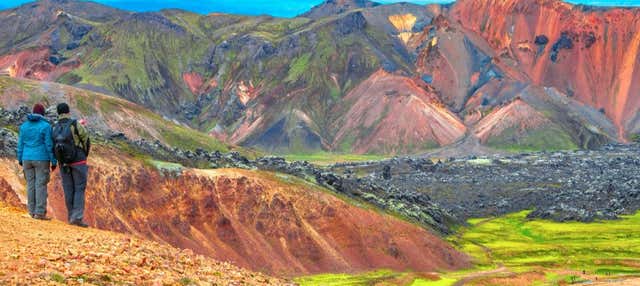 Landmannalaugar Small-Group Day Tripfrom €162See details ↗
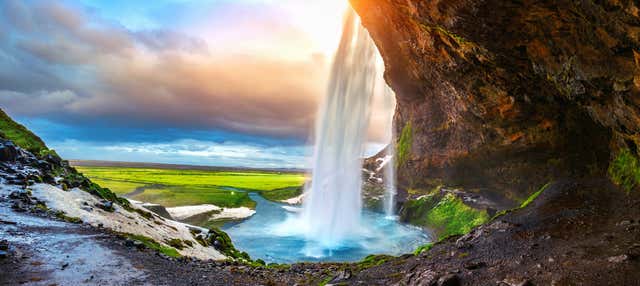 The South Coast of Iceland Day Tripfrom €129.49See details ↗
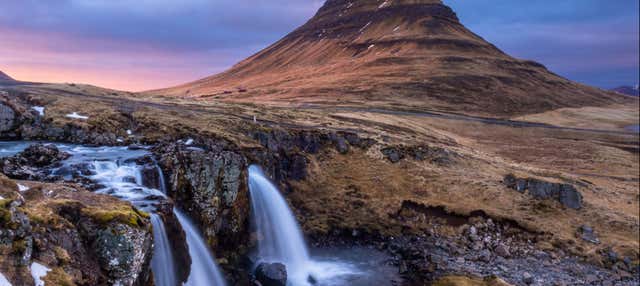 Snaefellsnes Day Tripfrom €126.54See details ↗
Affiliate links: if you book through them we may earn a commission, at no extra cost to you. It never changes our stage, distance or luggage information. (Civitatis) How the project is funded
The reason is the road network, or the absence of one. Landmannalaugar is reached by the F208, Álftavatn by a spur off the F210, Emstrur by a rough jeep track, and Þórsmörk by the F249, which fords the Krossá. These are unbridged mountain F-roads, legally restricted to modified four-wheel-drive vehicles, blocked by snow until late June and by meltwater after heavy rain. Hrafntinnusker, at 1,050 m in the rhyolite hills above Landmannalaugar, has no vehicle track at all. Nothing commercial can promise to reach any of them on a given afternoon.
So the pack is heavy by the standards of most routes on this site: commonly twelve to sixteen kilos. The huts provide a mattress and a kitchen, not bedding, so a sleeping bag is required. You carry all four days of food, a stove if you are camping, waterproofs that genuinely work, warm layers for wind chill on the Hrafntinnusker plateau where snow lies through summer, and shoes or sandals for wading the Bláfjallakvísl and the Þröngá. Fifty-five kilometres is short; the weight and the ground are what make it a real walk.
Hut beds are booked through the Icelandic touring association that owns them, and for a season that only runs from about late June to early September they sell out months ahead — some go the previous winter. Camping places are less pressured but still finite. Buses are booked separately, with a seat and any extra bag declared at the time. Build the plan in that order: hut nights, then buses, then what stays in Reykjavík. Weather closes the route occasionally, so keep a spare day and check the Icelandic road and safety services before travelling.
What it costs
Left luggage in Reykjavík runs roughly ISK 1,000 to 2,000 per bag per day and is often free at the hotel you are already using. The highland buses are the real expense, commonly ISK 10,000 to 16,000 each way, with a charge for a separately carried bag. Icelandic fares are revised every season and should be confirmed with the operator.
Which stages work
No section supports transfer between huts. Landmannalaugar and Þórsmörk both have scheduled highland bus services that carry bags, so a drop at either end is realistic. Hrafntinnusker, Álftavatn and Emstrur are reached only on foot or by modified four-wheel-drive vehicles, and nothing runs to them on a timetable.
Frequently asked
Could a jeep bring my bag to a hut?
In principle a modified four-wheel-drive vehicle can reach Álftavatn and Emstrur, and that is how the huts are supplied. It is not offered as a walker service. River levels change hour to hour, the F-roads close without notice, and no operator will commit to delivering a personal bag on a fixed day.
Do I need to carry a sleeping bag if I book a hut?
Yes. Icelandic mountain huts on this route provide a mattress and shared cooking facilities but no bedding, so a sleeping bag rated for cold nights is essential even in July. Nights at Hrafntinnusker sit close to freezing, and the hut is unheated in the sleeping areas. Earplugs help; the dormitories are crowded.
Where should I leave a suitcase?
In Reykjavík, at the hotel you stay in before and after, or at the bus terminal that runs the highland services. Since the route starts and ends in different places and the buses return to the capital, leaving a case there is simpler than trying to forward it. Ask about storage when you book the room.
How much food do I need to carry?
Four days, with a spare day’s worth in reserve. Landmannalaugar has a small shop with limited stock at high prices, and there is nothing between there and Þórsmörk. Most walkers take dehydrated meals and eat cold at lunch. Water is the one thing you do not carry much of: streams along the route are drinkable.
Check your route
Each trail guide states plainly how transfer works on that route.